---
title: "Ship data as you ship code: Tinybird becomes local-first"
excerpt: "Tinybird is local-first. Develop on your machine, test locally, deploy when ready. No cloud dependency during development."
authors: "Javi Santana"
categories: "Product updates"
createdOn: "2025-02-04 00:00:00"
publishedOn: "2025-02-05 00:00:00"
updatedOn: "2026-01-15 00:00:00"
status: "published"
---

<p>Tinybird started as a way to solve our own problem. We were a small team, drowning in data, short on time. So we built tooling to make working with large amounts of real-time data fast and easy. If you're wondering should we use tinybird in production or how do i start using tinybird, this post explains our local-first approach.</p><p>A few projects in, we realized we weren’t the only ones who needed this. So we turned it into a product. The best products start this way - <a href="https://paulgraham.com/growth.html"><u>solving your own problems first</u></a>.</p><p>That was five years ago. We’ve learned a lot since. Now, it’s time for us to apply that learning into the next iteration of Tinybird.</p><h2 id="the-dev-workflow-is-local">The dev workflow is local</h2><p>Tinybird was inspired by a core belief: When you’re working with data, you should be able to do it the same way you handle everything else in your dev stack.</p><p>You write code. You test it locally. You push it to GitHub. CI runs the build. It's deployed.&nbsp;</p><p>Regardless of the language or framework, that's the workflow. Changes are iterated and tested locally before anything is built on the server. The local workflow is foundational to writing, testing, and deploying good code.</p><h2 id="the-tinybird-local-workflow-is-coming">The Tinybird local workflow is coming</h2><p>Tinybird is changing. The days of logging into the UI in the browser and setting up your Workspace are ending. With Tinybird local, everything begins with local development.&nbsp;</p>
<!--kg-card-begin: html-->
<iframe width="100%" src="https://snippets.tinybird.co/XQAAAAI5AQAAAAAAAABBKUqGk9nLKurfQiIdwtaqqo8ABJitjI-eOn7j2ifgewm1jHuTLpfXRh8fXReX-IPLvCe7vWBRzas-A2PCfyGW3470marixs1ZXKuMk5K63fr3X6y_Kun7tjCkOFjTb6HRvitNx0dOK94u3AvZUf3LxldCqY1yM8by0bUYLOzxqf2Mzw91sekk8Fm4TCKfuU6lFQ7GWMeiVMjsGcbErPmi0Sy0Cmm52V6F0CzihQHtu_YQ0ZgRLLz3s8Zczomt0bXk9uS4wv08XY84LwDAGOHEShtEU2iJ9z4qUxVC2Z4uZsKVbIUSTeoJ-cStDbbTg_HoGXgEETZ0WRP7HEe5/embed"></iframe>
<!--kg-card-end: html-->
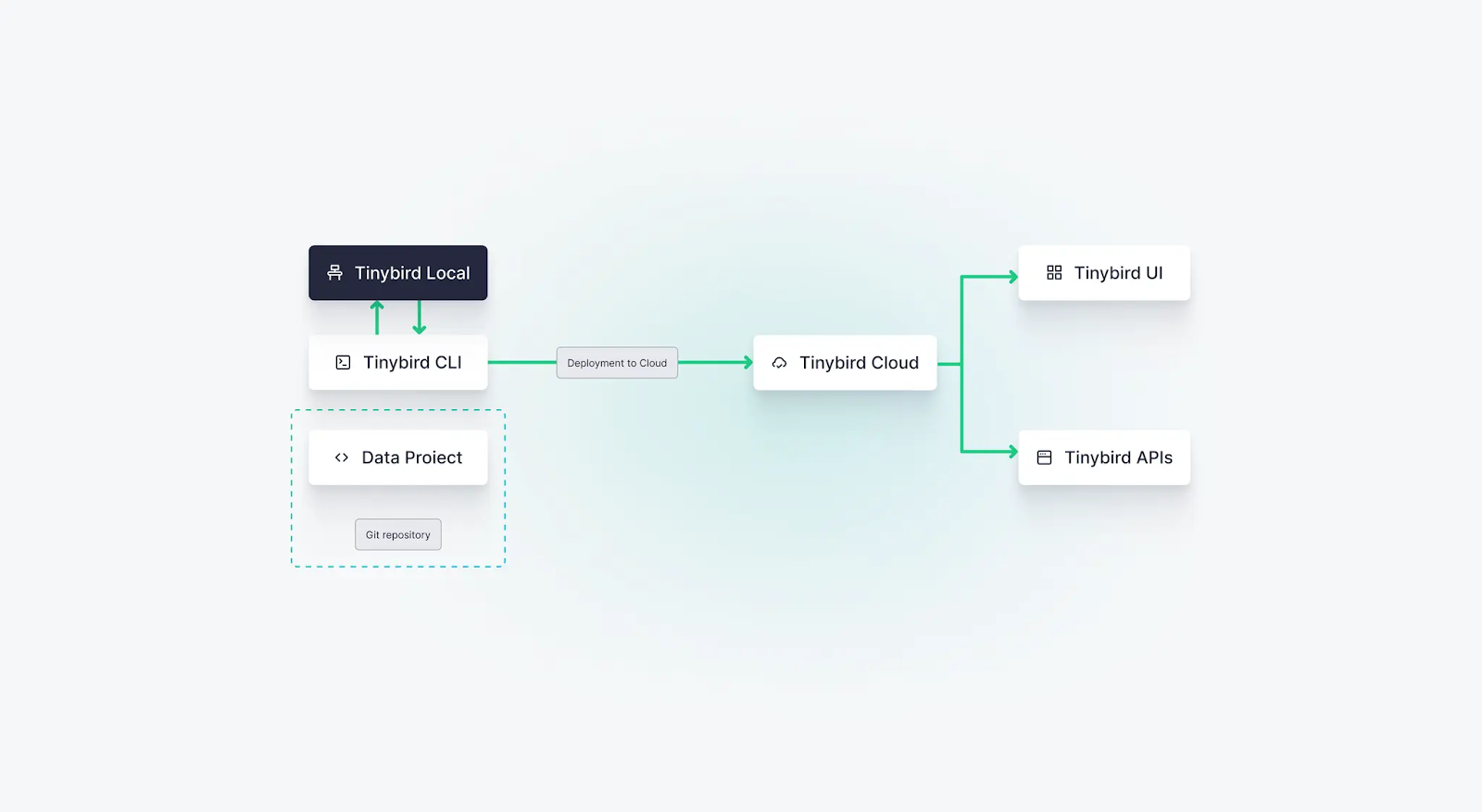
<p>No weird abstractions. No friction. Just the workflow you already know, but with a shit ton of data xD. The Tinybird Code CLI makes this seamless.</p><figure class="kg-card kg-image-card kg-card-hascaption"><img src="https://lh7-rt.googleusercontent.com/docsz/AD_4nXfCIxiIiQcju5r9qpYI6vhGKl8YnXUUcBes_Dn0fDyQ2mE9mirJ7dw19CaYsQTrRW3zLH64JzRzpMAqgk9RVneJwwc2Vg5Q3FI2H_8YDhBXpVpGtjyvvClVtXuba2DBZnoyF7jf?key=0VlM8l72jwMXU371A2VbSmqS" class="kg-image" alt="A diagram showing the new Tinybird local experience" loading="lazy" width="624" height="343"><figcaption><span style="white-space: pre-wrap;">The new Tinybird local experience</span></figcaption></figure><p>With Tinybird local, you will be able to:</p><ul><li>Build projects from scratch, locally.</li><li>Generate mock data, locally.</li><li>Run full project validation, locally.</li><li>Test APIs end to end, locally.</li><li>Deploy/rollback effortlessly with CI/CD.</li><li>Migrate schemas with zero downtime or data loss</li></ul><p>And since AI-powered IDEs are actually useful now, we're making sure Tinybird Code plays well with them. Let AI handle the boring parts. Follow us on Tinybird LinkedIn for updates.</p><p>Here's a sneak peek of how it looks in action (turn on the sound for some nice mech keyboard ASMR ;p):</p><figure class="kg-card kg-embed-card"><iframe width="200" height="113" src="https://www.youtube.com/embed/fVBJqMybj4A?feature=oembed" frameborder="0" allow="accelerometer; autoplay; clipboard-write; encrypted-media; gyroscope; picture-in-picture; web-share" referrerpolicy="strict-origin-when-cross-origin" allowfullscreen="" title="local env"></iframe></figure><h2 id="the-features-were-building">The features we're building</h2><p>With this shift, your data stack will no longer require a context switch. Tinybird's local-first is almost here, and this is what to expect:</p><ul><li>Data as Code</li><li>Full project validation during local build</li><li>Local &amp; Cloud runtime</li><li>End-to-end testing</li><li>Simple deployments/rollbacks</li><li>CI/CD integration</li><li>Live schema migrations without data loss</li><li>Built-in observability</li><li>AI-powered IDE integration</li><li>Scalable cloud</li></ul><p>This is how software teams work. It should be no different when you have a billion rows of event logs. You take care of shipping, we will take care of making it work (both locally and in prod).</p><h2 id="stay-tuned-for-the-tinybird-local-beta">Stay tuned for the Tinybird local beta</h2><p>The new Tinybird local experience will be in beta soon. Follow us on Tinybird LinkedIn to stay updated. If you want to try it, then follow us on <a href="https://x.com/tinybirdco" rel="noreferrer">Twitter</a> or <a href="https://www.linkedin.com/company/tinybird-co" rel="noreferrer">LinkedIn</a> or let us know in the <a href="https://www.tinybird.co/community" rel="noreferrer">Slack community</a>. We'll let you know as soon as it's ready to test. If you're asking should we use tinybird in production or how do i start using tinybird, tinybird local is the answer.</p>
