Data Platform

Write SQL,
get an API
or let AI agents query your data through MCP. One platform, every interface.
$ ❯ curl 'https://api.tinybird.co/v0/pipes/top_products.json' \ -H "Authorization: Bearer $TB_TOKEN" \ -d "category=electronics" \ -d "date_from=2026-01-01"
Want to query from your app? TypeScript and Python SDKs let you call your endpoints programmatically.
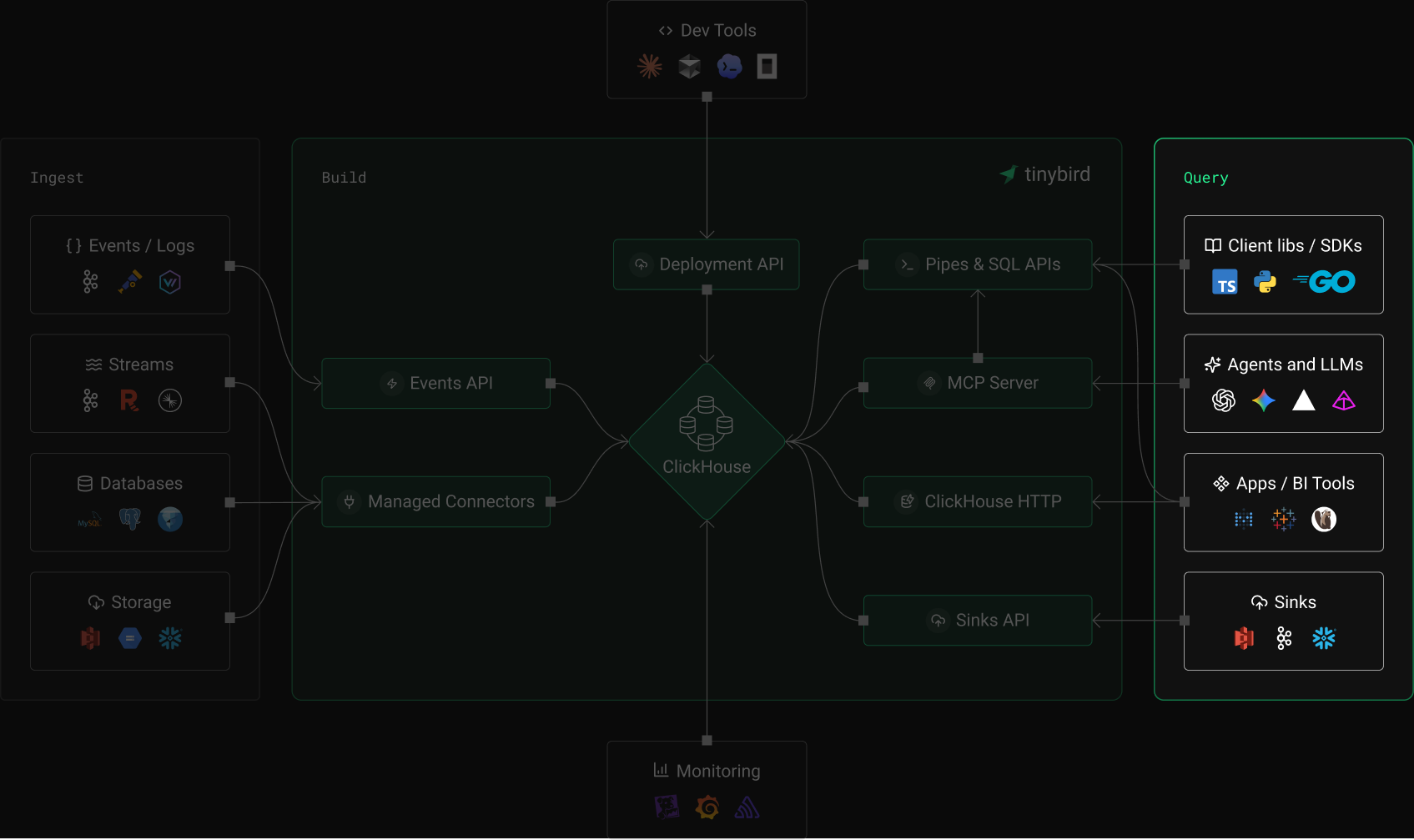
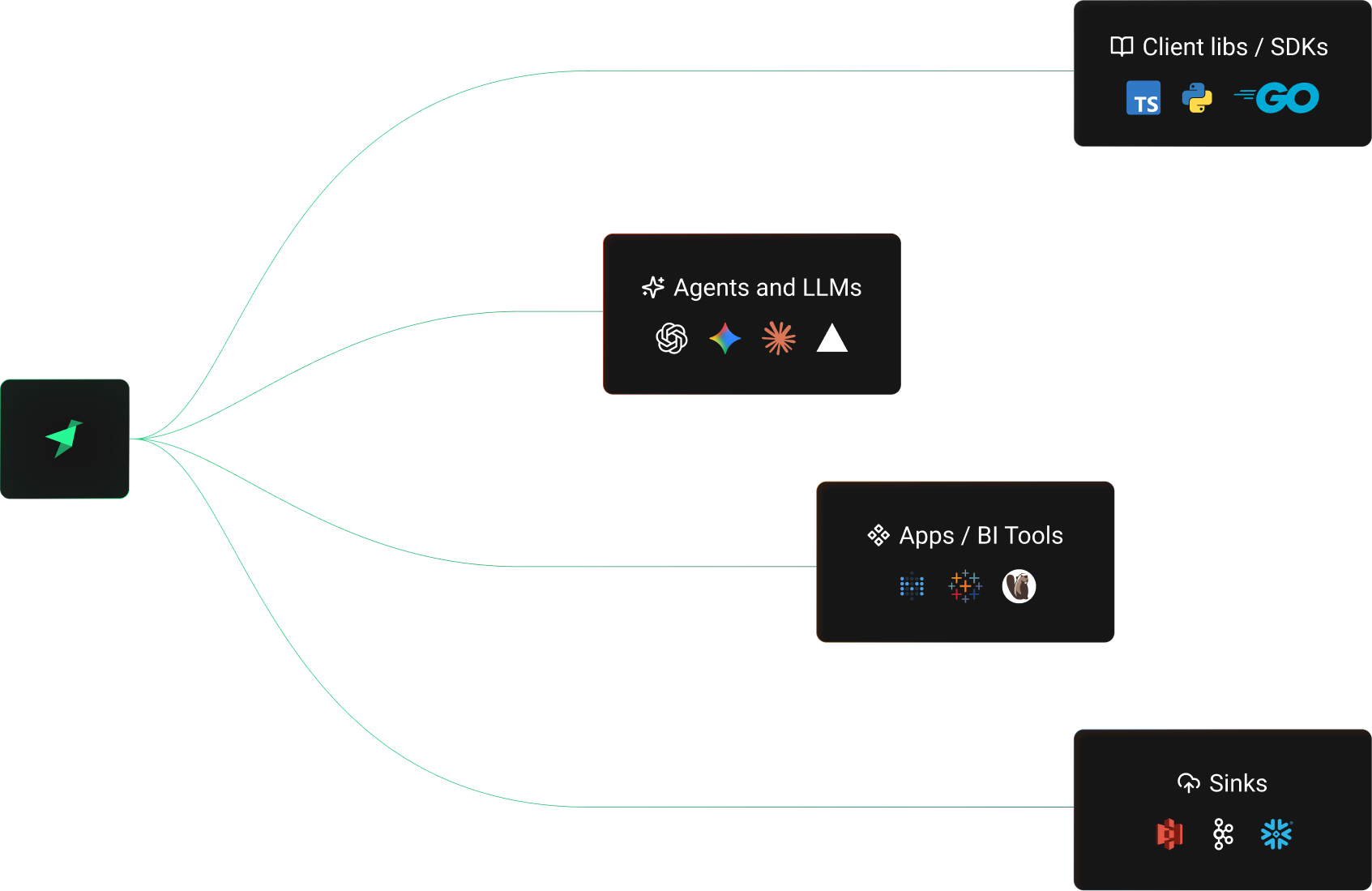
From pipe to every consumer
Real Query Use Cases
Sub-second APIs at scale,
zero infrastructure to manage
serves over 1 billion API requests per month with sub-400ms p95 latency.
per month
latency
per month
“Tinybird is the most exciting data company since Snowflake. It's revolutionized the way we think about real‑time data analytics at Vercel.”

Guillermo Rauch
CEO at Vercel

Why Tinybird
Stop building
API layers
api-plan.md
# DIY Query Layer
23
ClickHouse performance
4SQL-based queries
5- Build and maintain custom REST API layer6- Implement auth, rate limiting, and caching7- Write BI tool connectors or ETL exports8- Build export pipelines for downstream systems9- No native AI/agent integration10- Build documentation and SDKs manually11- Every new consumer means more code# Tinybird
23
ClickHouse performance
4SQL-based queries
5+ SQL → API in seconds, auto-scaled6+ Token-based auth with RBAC7+ Native ClickHouse interface for BI tools8+ Sinks: export to Kafka, S3, and GCS9+ Hosted MCP Server for AI agents10+ Auto-generated OpenAPI documentation11+ Apps, dashboards, and agents from one platform
Built for every consumer
The query layer
you don't have to build
Instant SQL APIs
- Turn SQL into REST APIs with dynamic parameters
- Auto-generated OpenAPI documentation
- Sub-second response times at any scale
BI tool integration
- Native ClickHouse HTTP interface over HTTPS
- Grafana, Tableau, Metabase, Looker, Power BI
- Read-only access with token-based auth
MCP Server
- Hosted MCP Server, zero setup required
- LLMs explore, query, and call your endpoints
- Full observability in service data sources
Materialized views
- Pre-aggregate data at ingest time for faster queries
- Always up-to-date as new data arrives
- Lower query latency and cost per query
Token-based security
- Static tokens and JWTs for every interface
- Row-Based Access Control (RBAC) per consumer
- Scoped tokens for BI tools and agents
Sinks and exports
- Push processed data to Kafka, S3, or GCS
- Scheduled or on-demand batch exports
- CSV, NDJSON, and Parquet formats
Need to explore your data first? Explorations, Playgrounds, and Time Series help you prototype queries and visualize data before publishing.

Get started
Consume your
data everywhere
FAQs
What are SQL API Endpoints?
Tinybird lets you turn any SQL query into a secure, low-latency REST API. Define your query with dynamic parameters, publish it, and consumers call it as a standard HTTP endpoint. Responses are in JSON by default, with CSV and NDJSON also available. Read the Endpoints docs.
What BI tools can I connect to Tinybird?
Any tool that supports the ClickHouse protocol: Grafana, Tableau, Metabase, Looker Studio, Power BI, Superset, Hex, DataGrip, DBeaver, and any other ClickHouse-compatible client. Connection is over HTTPS on port 443. Read the ClickHouse interface docs.
What is the Tinybird MCP Server?
A hosted Model Context Protocol server that gives AI agents structured access to your Tinybird workspace. Agents can explore data sources, run SQL queries, list and call your API endpoints. Every published endpoint is also exposed as an MCP tool that agents can discover and call. Authentication uses standard Tinybird tokens with enterprise-grade isolation. Read the MCP Server blog post.
How does authentication work?
All interfaces use Tinybird tokens. You can create static tokens or use JWTs for dynamic, user-scoped access. Row-Based Access Control (RBAC) policies let you control exactly which data each consumer — whether an application user, BI tool, or AI agent — can see. Learn about token permissions.
What's the latency for API Endpoints?
API Endpoints respond in milliseconds, backed by ClickHouse's columnar engine. Tinybird optimizes query execution and caching automatically. Latency depends on query complexity and data volume, but sub-100ms responses are typical for well-structured queries.
Can I use the ClickHouse interface with custom SQL clients?
Yes. Any client that speaks the ClickHouse HTTP protocol can connect: DataGrip, DBeaver, clickhouse-client, or custom scripts using the ClickHouse HTTP API. Connection is read-only by design.
How do I monitor queries from BI tools and MCP?
All queries are tracked in service data sources. BI tool queries appear in bi_stats_rt and bi_stats. MCP and API queries appear in pipe_stats_rt and pipe_stats. You can query these tables for free from Playgrounds, Time Series, or your own monitoring.
What MCP tools are available?
The MCP Server exposes: explore_data (inspect data sources), text_to_sql (natural language to SQL), execute_query (run SQL), list_endpoints and list_datasources (discover resources). Every published API endpoint is also exposed as an MCP tool that agents can discover and call.
Do API Endpoints auto-generate documentation?
Yes. Every endpoint gets auto-generated OpenAPI documentation. You can test parameters and preview responses directly from the docs page. The API host and endpoint URLs are accessible from the workspace overview.
What's the difference between the ClickHouse interface and SQL APIs?
SQL APIs (Endpoints) are purpose-built REST APIs with dynamic parameters, caching, and authentication, designed for applications and dashboards. The ClickHouse interface exposes your data sources for ad-hoc SQL queries from BI tools and SQL clients. Use SQL APIs when you need a productized, optimized endpoint. Use the ClickHouse interface when you need flexible, exploratory access.
Can I query data from the CLI?
Yes. The Tinybird CLI provides three query commands: tb endpoint data to call any published endpoint with parameters, tb sql to run arbitrary SQL over your pipes and data sources, and tb ch to query directly via the ClickHouse HTTP interface. Read the CLI docs.
Can I use the TypeScript or Python SDK to query data?
Yes. The TypeScript SDK and Python SDK let you define and call endpoints programmatically. They are primarily for building your data project, but you can also use them to query endpoints from application code.
What are Materialized Views?
Materialized Views let you pre-aggregate and transform data at ingest time. Instead of running expensive aggregations on every query, Tinybird continuously updates a derived dataset as new data arrives. This reduces query latency and cost per query, especially for high-volume use cases like counters, averages, and top-N rankings. Read the Materialized Views docs.
Can I export data from Tinybird to other systems?
Yes. Tinybird Sinks let you push processed data to Kafka topics, S3 buckets, or Google Cloud Storage. You can schedule exports with cron expressions or trigger them on-demand, and choose between CSV, NDJSON, and Parquet formats. Sinks are fully managed, so there is no infrastructure to maintain.
Can I explore data without writing SQL?
Yes. Tinybird Explorations is an AI-powered interface where you ask questions in natural language and get results without writing SQL. For hands-on SQL work, Playgrounds provide an interactive editor for prototyping queries before publishing them as APIs. Time Series lets you visually explore time-based data with charts and drill-down. Learn more on the Workspace page.

Start querying your real-time data
- Publish SQL APIs: Read the Endpoints docs
- Connect your BI tools: Read the ClickHouse interface docs
- Make your data LLM-ready: Read the MCP Server blog post
- Export to Kafka, S3, or GCS: Read the Sinks docs
- Build with the SDKs: TypeScript and Python