



Nobody ever got fired for buying IBM. Famous line, and there's truth behind it: they do very well what a big corporation needs to run smoothly.
If you've been around the industry long enough, you know there are companies that have always been there and will probably be around forever. Believe it or not, just like Google or Facebook, IBM was an absolute beast long before them. It was the OpenAI of its time. It innovated in mainframes, databases, the personal computer—things that are normal today but weren't half a century ago.
But IBM started living off past wins, and like many others, it was late to the cloud. Well, not exactly late: its real game has always been banks and large enterprises, and those move slowly, so there was no rush. Who would have told them that a retail company would end up eating the cloud and that all of the enterprises would want to move there?
When they saw their mainframe business going downhill, they started buying companies: Red Hat (for Linux and OpenShift, which landed strong in banks thanks to hybrid cloud), SoftLayer to build IBM Cloud, and so on.
IBM and Open Source
IBM has always had a strong relationship with open source. They even have a section on their website explaining they were contributing before open source was cool. The list of projects is no joke: IBMers have contributed a lot to the Linux Kernel, Docker, Kubernetes or Node.js. Those are core projects that shaped technology over the last 30 years.
In fact, if you look at stats from places like the Linux Foundation, IBM is at the top of the rankings (directly or through Red Hat).
But open source, as IBM itself says, wasn't always cool. Microsoft spent years mocking Linux and other open-source projects, trying to keep enterprises from running Linux on servers. They didn't do a bad job, but open source is just too good to lose. Today it's rare to find a big company whose tech stack isn't a mix of open-source projects.
Why Kafka and IBM?
The way technology lands and gets sold to enterprises has shifted—from a top-down sales push to a more bottom-up model, where developers choose what to use (sales comes later to close the deal).
And this is the key point: Kafka has become a commodity. There's no large company that isn't using Kafka or seriously thinking about it. It's the safe bet. Remember: nobody ever got fired for buying IBM. So buying Confluent is just another move to secure a safe place for enterprise. IBM did the same with the HashiCorp acquisition, which was already the safe choice for a lot of developer tooling in enterprise.
But what's going to happen to Kafka as open source? No one really knows, but my guess is: nothing at all. A few things point to that:
First, IBM acquisitions haven't really changed much after joining the company. For example, HashiCorp projects are still the same.
Second, IBM was already one of the top Kafka contributors, Confluent aside (directly or through Red Hat). Obviously, with the Confluent acquisition, they virtually control the project.
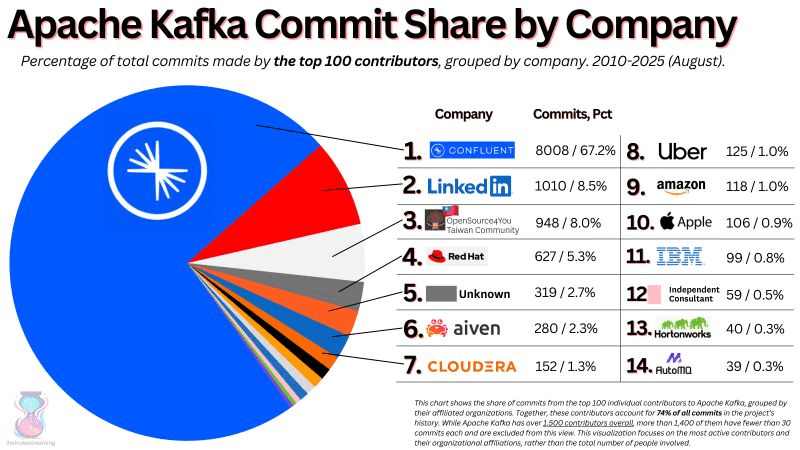 (source: a LinkedIn post by Stanislav Kozlovski—you should follow him if you want to learn more about Kafka and streaming)
Third, Kafka already has multiple implementations, forks, and companies that will keep the open-source side alive.
And fourth, Confluent already had a closed, cloud-only offering, so IBM doesn't need more leverage to sell to enterprise—it already has it. Even if it didn't, Confluent is still the IBM of Kafka providers: reliable, serious, expensive, and a little bit boring.
So IBM did exactly what it had to do: extend a big 6.4 billion check and buy the safe option, right when Confluent was starting to face competition and open-source projects were getting closer to feature parity with its cloud. On top of that, Kafka is the backbone of a company's data architecture, so the upsell potential is huge. I wouldn't be surprised if there were some very juicy spreadsheets with upsell projections behind this deal.


