
About the company
Guideless is an AI-powered software training and operational knowledge platform. Users perform a workflow once and Guideless turns it into an editable, AI-narrated guide that can be updated, translated, shared, embedded, or exported.
The company has more than 3,000 users across 15 markets, with teams at companies including Vinted, Masan Consumer Holdings, and the Nevada Hospital Association using the platform. Guideless recently raised a €1 million pre-seed round to accelerate product development and international expansion.
“Tinybird lets us build detailed, real-time insights into Guideless without having to build and maintain a separate analytics backend ourselves. More importantly, the data helps us understand how people actually engage with training, so we can improve the product and help our users create guides that people are more likely to watch all the way through.”
Rokas Balandis
Guideless
Problem
Guideless is a young company building in a market with a lot of uncertainty. The team needs to ship quickly, observe how users respond, and test its assumptions without committing engineering time to infrastructure before it knows exactly what the product will need.
That became particularly important when Guideless built Insights, its customer-facing analytics experience.
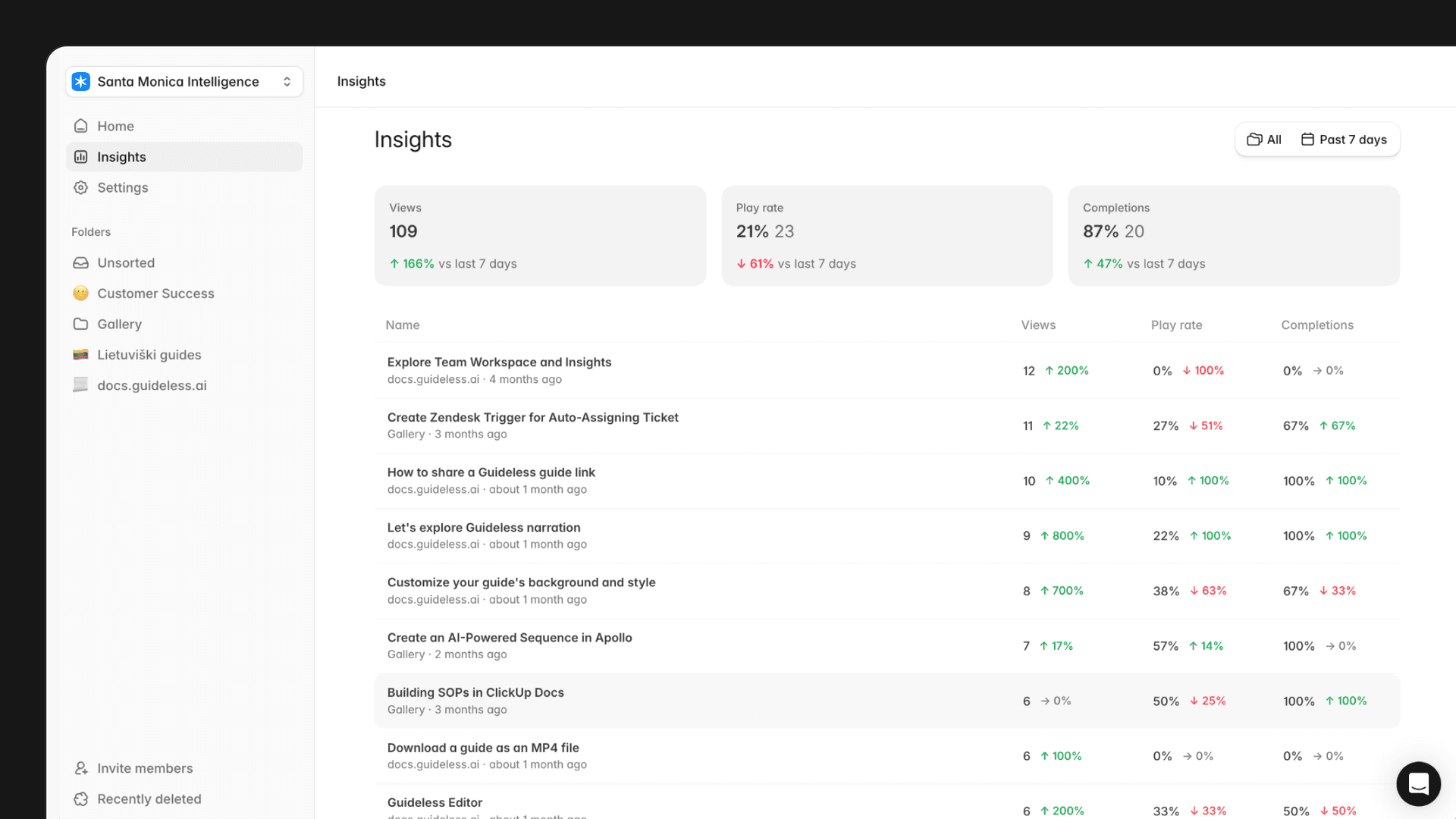
Guideless wanted users to see whether a guide had been viewed, whether someone actually pressed play, whether they completed it, how much time they spent watching, and exactly where they stopped progressing through the workflow.
Building that internally would have meant creating and maintaining a separate analytics database, ingestion system, aggregation logic, and query layer alongside the core Guideless product.
Why Tinybird
Tinybird gave Guideless a way to test the Insights experience quickly without first building an analytics stack of its own.
Real-time event ingestion and low-latency querying meant the team could capture detailed viewer behavior and immediately turn it into customer-facing metrics.
That fit the way Guideless wanted to operate: build the feature, see whether it creates value, and keep iterating.
The team estimates that Tinybird saved one to two weeks of initial engineering work, plus the ongoing maintenance of a separate analytics database and query layer.
When someone engages with a published Guideless guide, the product captures events including views, plays, completions, interaction time, and the steps the viewer reaches.
Those events pass through the Guideless backend into Tinybird, where they are stored and aggregated. Guideless queries the resulting data to power metrics including play rate, completion rate, total play time, and step-level drop-off.
Published guide → Guideless backend → Tinybird → Guideless Insights
Engagement data is changing how Guideless builds the product
The most interesting outcome is not how much data Guideless processes.
It is what that data has taught the team.
Guideless can compare guide structure with actual viewer completion, and a clear pattern has emerged: shorter guides are much more likely to be finished.
Guides containing four to five steps have an average completion rate of approximately 71%.
As guides get longer, completion falls:
- 4–5 steps: 71%
- 6–8 steps: 62%
- 9–12 steps: 59%
- 13+ steps: 44%
Duration tells an even clearer story.
Guides under 30 seconds have an average completion rate of approximately 66%. Once a guide exceeds two minutes, that falls to roughly 36%.
For Guideless, this turns analytics into a product feedback loop.
If users ask for increasingly long guides, the team does not have to rely on intuition to decide whether that is a good experience. It can look at how thousands of real viewing sessions behave and use that evidence to guide product decisions.
The question changes from "Can Guideless make an 80-step guide?" to "Will anyone finish it?"
Step-level analytics show exactly where viewers leave
The same feedback loop is available to Guideless customers.
Insights does not stop at an overall completion rate. Guideless uses the step-level data stored and aggregated in Tinybird to show how many unique viewers make it to each stage of a guide.
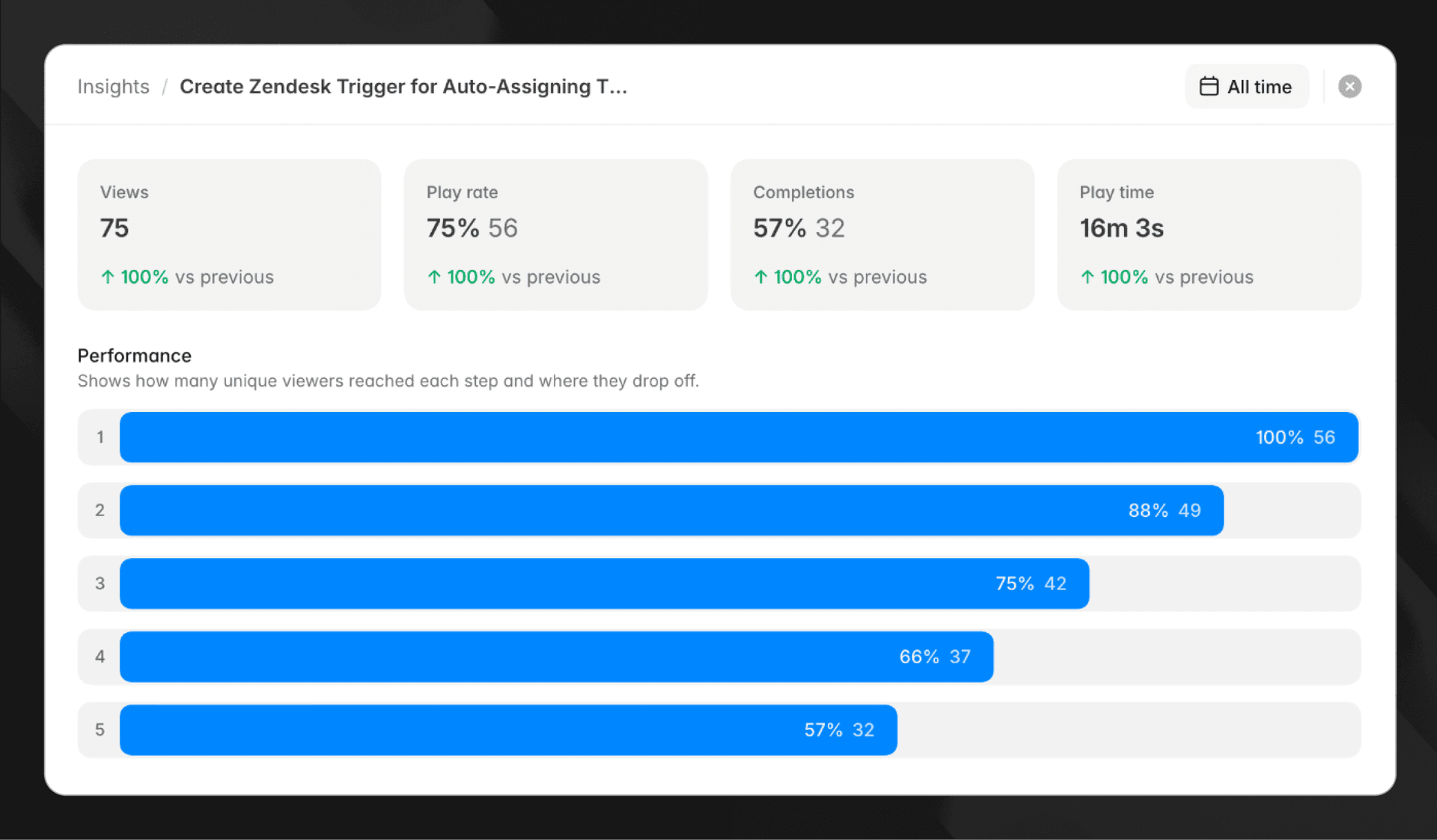
That makes it possible to identify the precise point where a training experience starts losing people.
One Guideless customer used drop-off data from a multi-step guide to identify where viewers were abandoning the workflow. They simplified the experience and moved the first useful action earlier in the guide.
Instead of treating engagement as a vanity metric, the customer could use it to change the training itself.
That is a much more useful analytics loop: publish, observe, find friction, improve.
Insights became part of the product Guideless sells
The analytics experience has also moved beyond an internal product-development tool.
Guideless includes Insights in its Pro plan, and the feature comes up in sales conversations as a clear differentiator.
Customers can see not only how many times training has been viewed, but whether people start it, whether they finish it, how completion is changing, and which individual guides are performing well.
That makes training measurable in a way that static documentation and conventional screen recordings often are not.
A team can create a guide, distribute it, and then see whether it is actually doing its job.
And because those metrics are backed by the same event pipeline Guideless uses to learn about its own product, improving the analytics experience improves both sides of the platform.
Guideless gets a better understanding of what makes training successful. Its users get the same data to improve their own content.
Building the analytics product, not the analytics infrastructure
For Guideless, Tinybird's value is ultimately about where a small team spends its time.
The company estimates that using Tinybird avoided roughly one to two weeks of work building the first version of its analytics backend. But the larger saving is ongoing.
The team does not need to maintain a separate analytics database and query layer as guide activity increases. Tinybird handles storage and real-time querying while Guideless engineers continue working on the product experience.
That matters as the company expands. Guideless already serves more than 3,000 users across 15 markets, and its new funding is intended in part to support expansion into the US, UK, and Europe.
As more guides are created and more people interact with them, the analytics workload will grow alongside the product.
Guideless can focus on what it learns from that data rather than the infrastructure required to query it.
“Tinybird let us build detailed, real-time insights into Guideless without having to build and maintain a separate analytics backend ourselves. More importantly, the data helps us understand how people actually engage with training, so we can improve the product and help our users create guides that people are more likely to watch all the way through.”
Rokas Balandis
Guideless
Guideless helps its users create training faster. Tinybird helps Guideless understand whether that training actually works.